


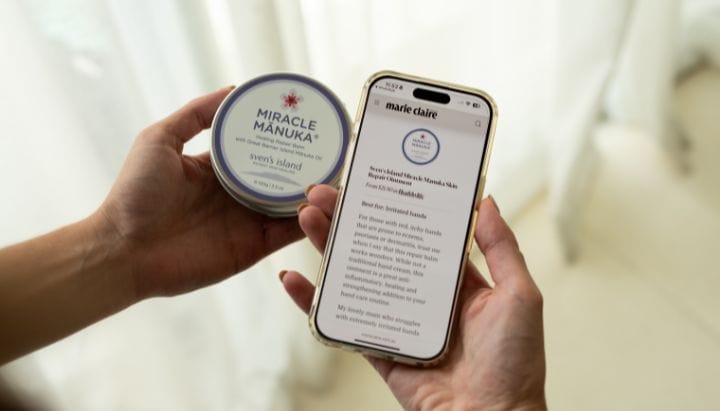


900+ clinicians shared our products on FrontrowMD, with no compensation.
Key Takeaways
-
"Eczema" and "atopic dermatitis" are often used interchangeably — but they don't mean exactly the same thing.
-
Eczema is an umbrella term covering several distinct skin conditions; atopic dermatitis is the most common type.
-
Atopic dermatitis involves a combination of genetic factors, immune system activity, and a compromised skin barrier — mechanisms that interact in ways researchers are still mapping.
-
Other eczema types — contact dermatitis, seborrhoeic dermatitis, and dyshidrotic eczema — tend to have different primary drivers, though overlap is common and more than one type can be active at the same time.
-
Understanding which type you're dealing with changes how you manage it — and which products are actually appropriate for your skin.
If you've ever Googled your way through a flare and come back more confused than when you started, you're not alone. The language around eczema is genuinely inconsistent, even among medical professionals. And the confusion isn't just semantic — it has real implications for how you manage your skin.
Here's what the distinction actually means, why it matters, and what it tells you about what's really driving your flares.
Eczema Is an Umbrella Term
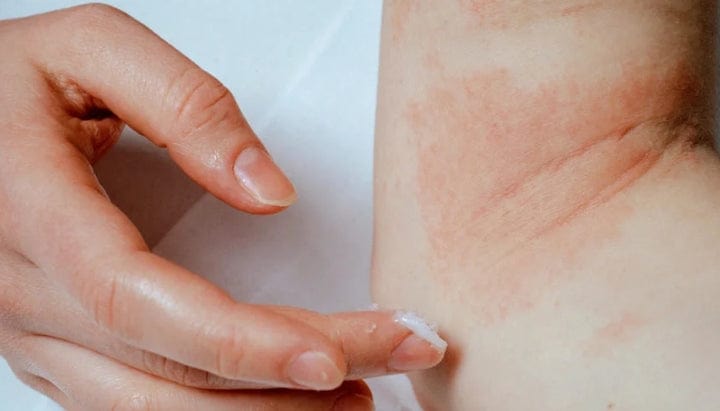
"Eczema" isn't a single diagnosis. It's a broad category — a way of describing a group of skin conditions that share certain characteristics: inflammation, itch, and a disrupted skin barrier.
Think of it the way you'd think of "headache." A migraine is a headache. So is a tension headache. But they have different causes, different mechanisms, and different treatment approaches. You wouldn't treat a tension headache the same way you'd treat a cluster headache, even though they're both headaches.
Eczema works the same way. There are several distinct types that fall under the eczema umbrella, and knowing which one you have — or which one your child has — shapes everything about how you approach it. 
The Main Types of Eczema
Atopic dermatitis is the most common form and what most people mean when they say "eczema." It's a chronic inflammatory condition strongly linked to genetics, immune system activity, and a compromised skin barrier — though exactly how these factors interact, and why the condition presents so differently from person to person, is still being mapped by researchers.
It tends to appear early in childhood, often alongside asthma and hay fever — what's known as the "atopic triad." It's characterised by intense itch, dry skin, and flares that come and go over time.
Contact dermatitis is a reaction to something that touches the skin directly. It comes in two forms: irritant contact dermatitis, caused by repeated exposure to something that physically damages the skin (soaps, cleaning products, harsh fabrics), and allergic contact dermatitis, an immune response to a specific allergen like nickel, fragrance, or latex.
The key difference from atopic dermatitis is that contact dermatitis has a specific external cause that, once identified and removed, often resolves the problem.
Seborrhoeic dermatitis affects areas rich in oil glands — the scalp, face, and chest. It causes red, scaly, greasy-looking patches and is associated with a yeast called Malassezia, which appears to play a role in driving the inflammatory response — though the full picture is more complex than a simple overgrowth.
In babies it's called cradle cap. In adults it tends to be chronic and cyclic.
Dyshidrotic eczema shows up as small, intensely itchy blisters on the hands and feet, particularly along the fingers and palms. It's often triggered by stress, heat, sweating, or allergen exposure.
It's less common but deeply disruptive when it flares — the location makes daily tasks painful.
There are other subtypes too — nummular eczema, neurodermatitis, stasis dermatitis — but atopic dermatitis, contact dermatitis, seborrhoeic, and dyshidrotic are the four most people encounter.
So What Makes Atopic Dermatitis Different?
Atopic dermatitis is the type most driven by what's happening underneath the skin, not just on its surface.
The "atopic" part refers to a genetic tendency toward immune overreaction. People with atopic dermatitis often have a mutation in the filaggrin gene — a protein that plays a critical role in maintaining the skin barrier. When filaggrin doesn't work properly, the skin barrier becomes permeable. Moisture escapes. Irritants and allergens get in. The immune system fires up in response — and the inflammation, itch, and redness of a flare begin.
This is why atopic dermatitis tends to be chronic and systemic in a way other eczema types aren't. It's not caused by a specific allergen you can simply remove. It's driven by an underlying barrier dysfunction that requires consistent, ongoing support — not just reactive treatment when things get bad.
The bacterial dimension matters here too. Research shows that the vast majority of atopic dermatitis-prone skin carries significantly elevated levels of Staphylococcus aureus (Staph) compared to healthy skin.
Staph disrupts the skin barrier further, triggers inflammatory responses, and worsens the itch-scratch cycle — meaning a flare can keep feeding itself even when the original trigger is long gone. Understanding why eczema keeps coming back often starts with understanding this bacterial connection.

Why the Distinction Matters for Management
If you have contact dermatitis, the primary goal is identifying and eliminating the trigger. Patch testing, a careful product audit, switching your washing detergent — these are meaningful interventions that can resolve the problem at its source.
If you have seborrhoeic dermatitis, antifungal treatments address the yeast component in a way that standard eczema creams don't.
It's also worth noting that these types don't always sit neatly in separate boxes. Someone with atopic dermatitis as their baseline can develop contact reactions on top of it — meaning two types are active simultaneously. That layering is one reason why a flare can persist even after you've removed what seemed like the obvious trigger.
If you have atopic dermatitis, no single-trigger approach will fully work — because the problem isn't one specific thing. It's a systemic barrier dysfunction combined with immune system activity and, frequently, a bacterial imbalance driving the cycle.
Consistent daily barrier support is the foundation. Moisturising is essential — it reduces water loss, softens the skin, and helps maintain the barrier between flares. But for atopic dermatitis specifically, a moisturiser that also addresses the bacterial drivers of flares tends to give more consistent results than one that only adds hydration back to the surface.
Repairing the skin barrier in eczema is a long-term commitment, not a one-cream fix — and understanding that is half the battle.
Does the Label Change What You Put on Your Skin?
Contact dermatitis calls for strict fragrance-free, minimal-ingredient formulas and the removal of the offending substance. Seborrhoeic dermatitis often needs specific antifungal actives.
For atopic dermatitis, the priority is a formula that supports barrier repair and addresses the bacterial drivers of flares alongside regular moisturising — not instead of it. Fragrance-free is non-negotiable.
For consistent daily use between flares — particularly on children's sensitive skin — many families look for steroid-free options. Topical steroids have their place when prescribed and used appropriately, but they're not designed for continuous daily use long-term. Skin thinning, rebound flares, and reduced effectiveness over time are well-documented steroid concerns that most people managing chronic eczema are already aware of.
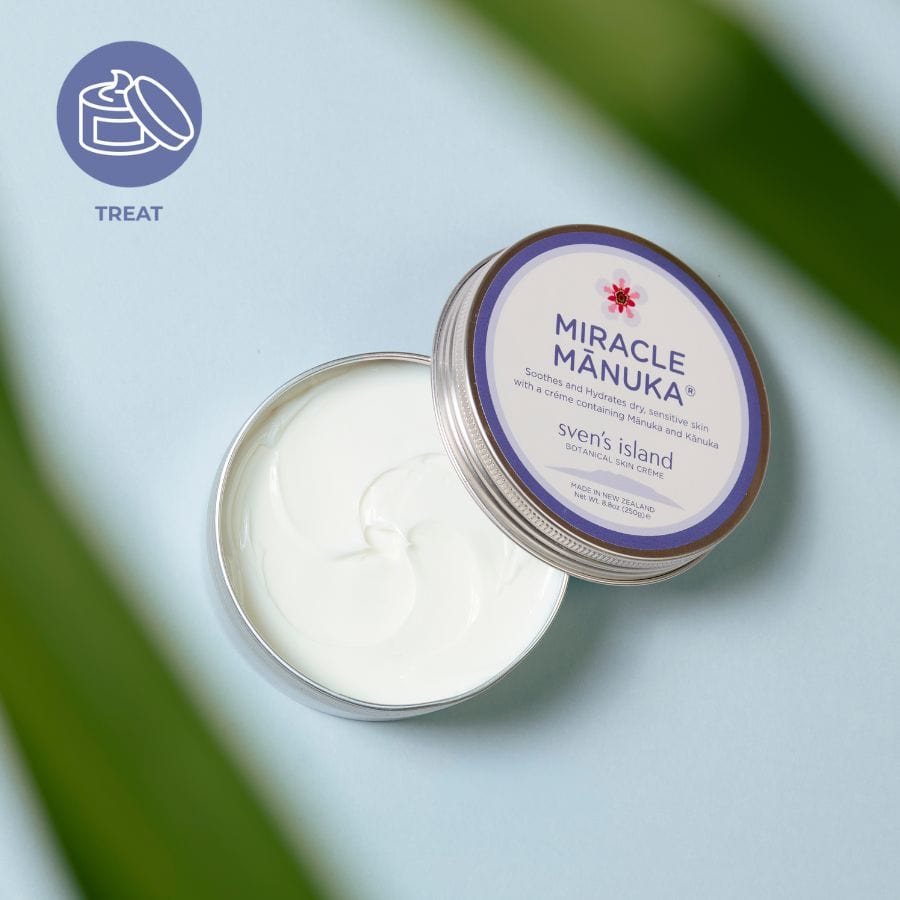
Sven's Island Miracle Manuka Creme is formulated with Manuka leaf oil, clinically shown to fight Staph bacteria, alongside Kanuka and Marshmallow Root to support barrier repair — steroid-free, fragrance-free, and safe from birth.
It's designed for consistent daily use, without the trade-offs that come with long-term steroid use.
How you stop eczema itching fast during a flare is a different question from how you prevent the next flare — and the answer to both involves understanding the barrier-bacteria relationship that drives atopic dermatitis specifically.
What the Research Shows
Research consistently shows that atopic dermatitis involves three overlapping mechanisms: genetic skin barrier dysfunction (particularly filaggrin mutations), an immune response skewed toward the Th2 pathway that drives inflammation, and Staph colonisation that perpetuates the flare cycle.¹
Studies confirm that 70–90% of atopic dermatitis lesions are colonised by Staph, compared to 20–30% of healthy skin — and that colonisation density correlates with flare severity.² This bacterial imbalance is now considered a major driver of the itch-scratch cycle, not just a secondary complication.³
The filaggrin gene mutation has been identified as one of the strongest genetic risk factors for atopic dermatitis, present in approximately 30% of European patients with the condition.⁴ Loss of filaggrin directly increases transepidermal water loss (TEWL), reducing the skin's ability to retain moisture and maintain its protective function.⁵
Understanding the bacterial cycle is particularly important for parents managing a child's atopic dermatitis — research shows the Staph-barrier-inflammation loop can sustain flares independently of the original trigger once established.³
Frequently Asked Questions
Is atopic dermatitis the same as eczema?
Atopic dermatitis is the most common type of eczema, but not all eczema is atopic dermatitis. "Eczema" is an umbrella term covering several conditions — including contact dermatitis, seborrhoeic dermatitis, and dyshidrotic eczema — that share inflammation and skin barrier disruption but have different causes and management approaches.
How do I know if I have atopic dermatitis or contact dermatitis?
Atopic dermatitis tends to be chronic, appears in childhood, and flares without a single identifiable cause. Contact dermatitis appears after exposure to a specific irritant or allergen and typically resolves when that substance is removed. A dermatologist can conduct patch testing to identify contact allergen triggers if you're unsure.
Can you have more than one type of eczema at the same time?
Yes. It's possible to have atopic dermatitis as your baseline condition and also develop contact dermatitis in response to a specific product or substance. Both can be active simultaneously, which is one reason why carefully auditing your skincare routine matters — some products can trigger contact reactions on already-compromised atopic skin.
Does atopic dermatitis go away?
For many children, atopic dermatitis improves significantly or goes into long-term remission by adolescence. For others, it continues into adulthood or first appears in adulthood. It's a chronic condition that can be managed effectively — but there's no universally consistent pattern, and expecting it to resolve on its own timeline without ongoing barrier support tends to lead to more frustration than results.
What ingredients should I look for in a cream for atopic dermatitis?
Look for steroid-free, fragrance-free formulas with ingredients that support the skin barrier — occlusives to reduce water loss, humectants to draw moisture in, and active botanicals with demonstrated antibacterial properties to address the Staph component of flares. Ingredients clinically shown to fight Staph bacteria are particularly relevant for atopic dermatitis, where the bacterial cycle plays a central role in keeping flares active.
A Final Thought
The difference between "eczema" and "atopic dermatitis" isn't just a clinical technicality. It's the difference between knowing what's actually driving your symptoms and guessing.
Atopic dermatitis is chronic, systemic, and driven by a combination of barrier dysfunction and bacterial imbalance that most standard creams don't address.
If you've been through product after product without lasting relief, it's worth asking whether what you've been using addresses the underlying triggers — or just the surface.
More than 100,000 Australian families have made the switch: Try Sven's Island Miracle Manuka Cream for 60 days — if your skin doesn't improve, get your money back. No questions asked.
References
¹ Weidinger S, Novak N. (2016). Atopic dermatitis. The Lancet, 387(10023):1109–1122. https://pubmed.ncbi.nlm.nih.gov/26377142/
² Totté JEE, van der Feltz WT, Hennekam M, et al. (2016). Prevalence and odds of Staphylococcus aureus carriage in atopic dermatitis: a systematic review and meta-analysis. Journal of Allergy and Clinical Immunology, 137(4):1082–1091. https://pubmed.ncbi.nlm.nih.gov/26732754/
³ Geoghegan JA, Irvine AD, Foster TJ. (2018). Staphylococcus aureus and atopic dermatitis: a complex and evolving relationship. Trends in Microbiology, 26(6):484–497. https://pubmed.ncbi.nlm.nih.gov/29373185/
⁴ Palmer CNA, Irvine AD, Terron-Kwiatkowski A, et al. (2006). Common loss-of-function variants of the epidermal barrier protein filaggrin are a major predisposing factor for atopic dermatitis. Nature Genetics, 38(4):441–446. https://pubmed.ncbi.nlm.nih.gov/16550169/
⁵ Flohr C, England K, Radulovic S, et al. (2010). Filaggrin loss-of-function mutations are associated with early-onset eczema, eczema severity and transepidermal water loss at 3 months of age. British Journal of Dermatology, 163(6):1333–1336. https://pubmed.ncbi.nlm.nih.gov/20716217/
Don’t Miss These
Works well with SELF-CARE


- £7.00 GBP
-
£11.00 - £7.00 GBP
- -36%
- Unit price
- per


- £26.40 GBP
-
£64.00 - £26.40 GBP
- -31%
- Unit price
- per
- £35.20 GBP
-
£51.00 - £35.20 GBP
- -14%
- Unit price
- per


- £24.80 GBP
-
£60.00 - £24.80 GBP
- -48%
- Unit price
- per


